Grease, Code Violations, and Liability: What Restaurant Owners Lose by Skipping Exterior Pressure Washing
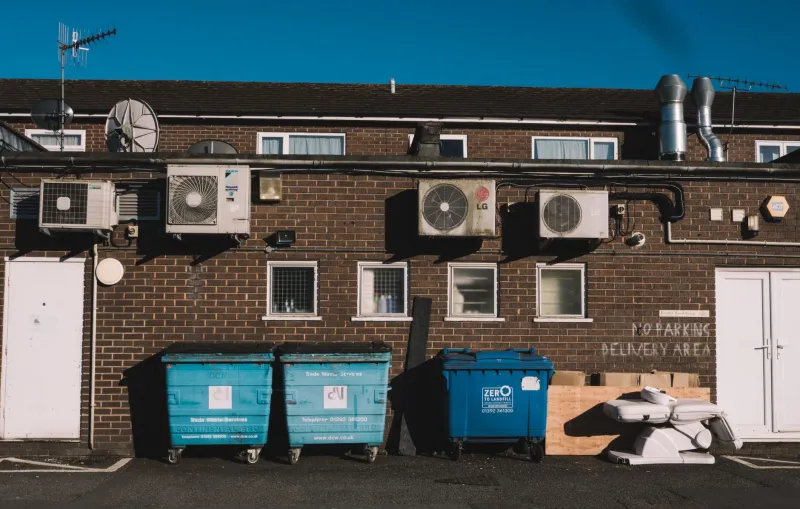
For most restaurant operators, the cleaning checklist ends at the kitchen door. Fryers are filtered, hoods are wiped down, and floors are mopped with the kind of disciplined regularity that health inspectors expect. But step outside — around the back of the building, up toward the roofline, or alongside the HVAC condenser units — and a different story begins to take shape. One written in accumulated grease, biological residue, and deferred maintenance.
This is not a minor oversight. It is a financial and regulatory liability that compounds quietly over months and years, right up until it doesn't.
Where Grease Actually Goes After It Leaves the Kitchen
Exhaust systems are designed to carry heat and vapor away from cooking surfaces, but they are not airtight. Grease-laden air escapes through rooftop exhaust fans, condenser coils, and the gaps in aging ductwork, then settles on every nearby surface. Roofing membranes, exterior walls, loading platforms, and HVAC units all absorb this residue over time.
The result is a slow-building coating that most owners never see because it accumulates in places they rarely inspect. Rooftop grease deposits, in particular, are notorious for going unnoticed until a fire marshal flags them or a roof warranty is voided due to improper maintenance. The National Fire Protection Association (NFPA) has long recognized grease accumulation on exterior surfaces as a legitimate fire risk — one that insurance carriers take seriously when evaluating claims.
Health Code Implications That Extend Beyond the Kitchen
Many restaurant operators assume that health inspections focus exclusively on interior food-handling areas. In practice, municipal health departments across the United States have broadened their inspection criteria to include exterior premises, dumpster enclosures, and the immediate perimeter of the building.
Grease-coated surfaces adjacent to service entrances, delivery areas, and back-of-house zones create exactly the kind of unsanitary conditions that inspectors are trained to document. Beyond the visual citation, there is a more consequential problem: grease is an extraordinarily effective attractant for pests.
Cockroaches, rodents, and flies are drawn to the organic residue left behind by cooking operations. When that residue migrates to exterior surfaces — particularly around exhaust vents, dumpster pads, and loading areas — it creates a sustained invitation that pest control services alone cannot fully address. Eliminating the food source, not just the pest, is the only durable solution. That requires professional-grade pressure washing with the appropriate cleaning agents and water temperatures to fully emulsify and remove accumulated grease.
A single pest-related health code violation can result in fines ranging from several hundred to several thousand dollars, depending on the jurisdiction. A closure order, even a temporary one, carries costs that dwarf any routine cleaning budget.
The Insurance Angle Most Owners Overlook
Commercial property and general liability insurance policies contain maintenance clauses that are rarely read in detail until a claim is filed. When grease accumulation on a rooftop contributes to a fire, or when a slip-and-fall incident occurs on a grease-contaminated loading surface, carriers routinely investigate whether the property owner exercised reasonable maintenance practices.
If the answer is no — and an unaddressed grease buildup spanning multiple seasons is difficult to characterize as reasonable maintenance — the insurer has grounds to reduce or deny the claim. This is not a theoretical risk. It is a documented pattern in commercial property claims, and it places restaurant operators in a particularly vulnerable position given the volume of grease their operations produce.
Documented, recurring professional cleaning creates a paper trail that demonstrates due diligence. That documentation has real value in the event of a dispute.
Reactive Service Costs More Than Preventive Maintenance — Every Time
The economic argument for routine pressure washing is straightforward when the numbers are examined honestly.
A professional exterior cleaning service for a mid-sized restaurant — covering the roofline, exhaust areas, HVAC units, dumpster enclosure, and rear service areas — typically runs between $300 and $800 per visit depending on facility size and grease load. Scheduled quarterly, that represents an annual investment in the range of $1,200 to $3,200.
Contrast that with the cost of emergency remediation after a grease fire damages roofing materials: roof repair or replacement costs for commercial properties routinely run from $10,000 to $50,000 or more. A single health code closure, factoring in lost revenue, staff wages, and potential legal fees, can easily exceed $20,000. Pest remediation for a severe infestation — one that required regulatory intervention — often costs between $5,000 and $15,000, not including the reputational damage that accompanies a public citation.
The math is not subtle. Preventive cleaning is not an operating expense to be minimized. It is a risk management tool with a measurable return.
What Professional Pressure Washing Actually Addresses
Not all cleaning approaches are equally effective against commercial-grade grease. Consumer-grade pressure washers and general-purpose cleaning solutions do not generate the combination of temperature, pressure, and chemical action required to fully break down polymerized cooking grease on exterior surfaces.
Industrial pressure washing services use hot water extraction systems — often operating above 200 degrees Fahrenheit — combined with food-safe degreasers formulated for high-volume cooking environments. This combination emulsifies grease at the molecular level rather than simply displacing it. The result is a surface that is genuinely clean, not merely rinsed.
For restaurant operators, this distinction matters because partially cleaned surfaces re-accumulate grease faster than properly cleaned ones. A superficial cleaning that leaves behind a residual film shortens the effective maintenance interval and ultimately costs more over time.
Building a Cleaning Schedule That Works for Your Operation
The appropriate cleaning frequency for a restaurant's exterior surfaces depends on several variables: cooking volume, the type of cuisine being prepared, the age and condition of the exhaust system, and local climate conditions. A high-volume fried food operation in a humid Southern climate will accumulate grease significantly faster than a lighter-fare establishment in a drier region.
As a general baseline, most commercial kitchens benefit from quarterly exterior pressure washing, with additional service following periods of unusually high volume — major holidays, catering seasons, or event-driven surges. Facilities that have fallen behind on maintenance may require an initial deep-clean service before a routine schedule can be established.
The key is consistency. A documented, recurring cleaning program is both operationally effective and legally defensible — two qualities that any restaurant operator should value equally.
At Evershine Power Laundry, we work with food service facilities across the region to develop cleaning protocols that meet regulatory standards, protect property assets, and keep exterior surfaces in the kind of condition that reflects the quality of the operation inside. Industrial-grade clean is not a luxury for restaurants. It is a baseline requirement that the industry too often treats as optional — until it isn't.