Four Seasons, Four Threats: Why a Fixed Cleaning Schedule Leaves Your Facility Exposed Year-Round
The Assumption That Costs Facilities Thousands Each Year
Most facility managers understand, at least in principle, that cleaning is not a one-time event. Yet the operational reality inside many commercial and industrial properties tells a different story: a scheduled deep clean in early spring, perhaps a follow-up before the holiday slowdown, and reactive spot treatments whenever something becomes visually unacceptable. This model feels manageable. It is also, by nearly every operational and compliance metric, insufficient.
The core problem is not frequency—it is adaptability. The contaminants that threaten your surfaces, your equipment, and your regulatory standing do not arrive on a fixed schedule. They arrive with the weather, with the seasons, and with the biological and chemical processes those seasons set in motion. A static cleaning calendar cannot respond to dynamic environmental pressure. And when the calendar falls behind, facilities pay—in accelerated material degradation, in compliance exposure, and in operational disruptions that compound over time.
Winter: The Salt and Moisture Problem That Doesn't End When the Snow Does
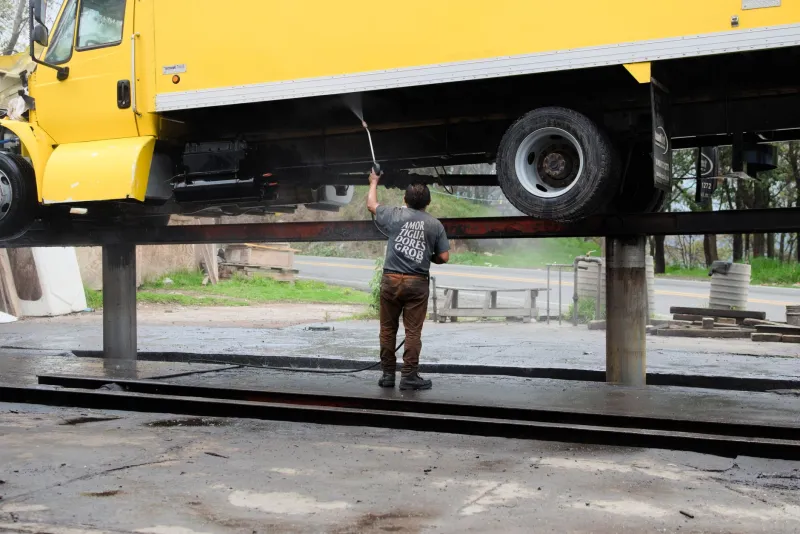
In northern and mid-Atlantic states, road salt application begins as early as November and continues through March. That salt does not stay on the road. It migrates onto loading dock aprons, parking structures, entry thresholds, and the lower exteriors of buildings through vehicle traffic, foot traffic, and wind dispersion. Chloride compounds in road salt are among the most aggressive accelerants of concrete deterioration and metal corrosion available in any natural environment.
The damage is not always visible. Salt infiltrates the microporous structure of concrete, where it initiates a freeze-thaw cycle that progressively fractures the material from within. On exposed metal—dock levelers, railings, HVAC supports, exterior fixtures—it catalyzes oxidation at a rate that can render components structurally compromised within a single winter season if untreated.
The critical operational insight here is that the threat does not conclude when temperatures rise. Salt residue that has not been removed by targeted pressure washing continues to act on surfaces through the spring thaw, often accelerating damage precisely when facility managers believe the risk has passed. A cleaning strategy that waits until April to address winter contamination has already allowed months of unchecked chemical activity.
Spring: When Biological Pressure Builds Faster Than Most Schedules Allow
The conditions that define spring in most of the United States—rising temperatures, increased moisture, extended daylight—are also the precise conditions under which microbial and botanical contamination accelerates most rapidly. Algae, mold spores, and bacterial biofilms that have remained dormant through the winter activate quickly once ambient temperatures climb above 50 degrees Fahrenheit.
For facilities with porous exterior surfaces—concrete, brick, textured cladding—spring represents a narrow window during which proactive cleaning can interrupt colonization before it becomes entrenched. Once algae or biofilm has established a structural foothold, removal requires significantly greater chemical intervention and mechanical force. The cost differential between early-season prevention and mid-season remediation is not marginal; it is often substantial.
Spring also introduces pollen accumulation, which creates its own set of complications. Pollen deposits on HVAC intake surfaces, rooftop equipment, and building exteriors combine with moisture to form a nutrient-rich substrate that accelerates microbial growth. Facilities that skip spring exterior washing frequently discover elevated indoor air quality complaints and HVAC efficiency losses by midsummer—both of which carry direct operational costs.
Summer: Heat, Humidity, and the Grease-Accumulation Window
For food processing facilities, commercial kitchens, and any operation involving petroleum-based lubricants or organic materials, summer represents the highest-risk quarter for surface contamination. Elevated temperatures accelerate the oxidation and polymerization of grease deposits, converting them from relatively removable films into hardened, adhesive residues that bond aggressively to concrete and metal surfaces.
On building exteriors, summer heat combined with high humidity creates ideal conditions for algae bloom expansion. What appeared as minor surface discoloration in late spring can develop into dense biological growth by August, particularly on north-facing and shaded surfaces that retain moisture. In coastal and southeastern states, this cycle operates year-round but intensifies sharply during summer months.
For facilities subject to health department or fire code inspection, summer grease accumulation on exterior surfaces—particularly around exhaust venting, dumpster enclosures, and loading areas—represents a documented compliance liability. Inspectors operating under municipal fire codes in states including California, Texas, and Florida have specific standards governing exterior grease accumulation, and violations issued during summer inspection cycles carry the same financial and operational consequences as those issued at any other time of year.
Autumn: The Debris Problem That Becomes a Structural Problem
Leaf accumulation is frequently dismissed as an aesthetic concern. In operational terms, it is a drainage threat, a slip hazard, and a moisture retention mechanism that accelerates surface degradation throughout the fall and into winter.
Decomposing organic material in gutters, on rooftop surfaces, and in drainage channels creates blockages that redirect water toward building foundations and below-grade infrastructure. In facilities with flat or low-slope roofing, standing water resulting from debris-blocked drainage is one of the leading causes of premature membrane failure—a capital replacement cost that dwarfs any seasonal cleaning expenditure many times over.
At grade level, wet leaf accumulation on walkways, dock approaches, and parking surfaces creates documented slip-and-fall liability. In states with active workers' compensation litigation environments, a single incident traceable to unmaintained exterior surfaces can generate legal and insurance costs that exceed an entire year's professional cleaning budget.
Autumn is also the last viable window before winter for addressing surface contamination that, if left in place, will be compounded by salt and freeze-thaw activity over the following months. Facilities that allow biological growth, grease deposits, or mineral accumulation to persist through October are effectively pre-loading their surfaces with compounded damage before the most chemically aggressive season of the year begins.
Building a Calendar That Moves With the Environment
The framework for a dynamic maintenance calendar begins with a simple premise: cleaning intervals should be set by contamination rates, not by administrative convenience. For most industrial and commercial facilities operating in temperate US climates, this translates to a minimum of four distinct cleaning interventions per year, each timed to address the specific threat profile of the preceding season.
A pre-winter salt removal and surface sealing cycle in late October or November interrupts the freeze-thaw damage mechanism before it begins. An early spring biological intervention—targeting algae, mold, and biofilm before colonization matures—protects both surfaces and indoor air quality through the warmer months. A midsummer grease and organic residue treatment addresses the accumulation that heat accelerates. And an autumn debris removal and drainage clearing cycle closes the loop before the cycle restarts.
Within each of these four anchor interventions, specific surface categories warrant adjusted scheduling based on use intensity and exposure. High-traffic concrete, exterior metal, rooftop equipment, and drainage infrastructure each carry different contamination rates and therefore require independent assessment rather than uniform treatment intervals.
Static Schedules Are a Form of Deferred Risk
Every month that a cleaning protocol fails to respond to the actual contamination state of a facility's surfaces is a month during which degradation compounds, compliance exposure accumulates, and remediation costs grow. The seasonal contamination cycle does not pause for administrative calendars. It operates continuously, driven by temperature, moisture, biology, and chemistry that are indifferent to budget cycles or scheduling convenience.
Facilities that align their maintenance protocols with these environmental realities—rather than against them—consistently demonstrate lower long-term surface replacement costs, stronger inspection outcomes, and fewer emergency remediation events. The investment in a dynamic, season-responsive cleaning calendar is not an operational luxury. For facilities operating at commercial or industrial scale, it is the baseline standard that static annual cleaning has never actually met.