Spill Today, Shutdown Tomorrow: Why the First 72 Hours After Organic Contamination Define Your Facility's Regulatory Future
In commercial and industrial environments, spills are inevitable. Grease escapes a fitting. A floor drain backs up. An organic material — food byproduct, wastewater, animal fat — reaches an unsealed concrete surface and spreads. In the moment, the incident often looks minor. Manageable. Something to address at the end of the shift, or perhaps the following morning.
That calculation is almost always wrong.
What appears to be a localized spill is, in biological terms, an open invitation. Within hours — not days — bacterial populations can establish themselves on contaminated surfaces, and within 72 hours, what began as a contained incident can evolve into a facility-wide contamination event with direct implications for health code compliance, insurance standing, and operational continuity.
For facility managers responsible for food processing plants, commercial kitchens, healthcare-adjacent environments, or any regulated industrial space, the 72-hour window is not a guideline. It is a hard biological boundary.
What Happens on the Surface After a Spill
The microbiology of surface contamination follows a predictable and well-documented progression. When organic material — grease, food residue, wastewater, or biological fluids — contacts a porous or semi-porous surface, it provides an immediate nutrient source for ambient bacteria already present in the environment.
Under moderate temperature and humidity conditions, common in most US commercial facilities, bacterial populations can double every 20 minutes. A surface that harbors a modest initial colony can, within 24 hours, support a population in the millions. By hour 48, biofilm formation begins in earnest — a structured microbial community encased in a self-produced matrix that adheres to surfaces and dramatically increases resistance to standard cleaning agents.
By the 72-hour mark, that biofilm is no longer a surface-level concern. It has penetrated grout lines, expanded along floor joints, and potentially migrated toward floor drains, wall bases, and any adjacent porous material. What started as a spill has become a colonization event.
The Regulatory Dimension
Health inspectors and regulatory agencies in the United States — including local health departments, the FDA for food-related facilities, and OSHA for industrial environments — do not evaluate contamination based on what a surface looks like. They evaluate it based on what is present, and modern inspection protocols increasingly include swab testing, ATP bioluminescence readings, and direct biofilm identification.
A surface that appears clean to the naked eye can still fail a microbial surface test if biofilm has established itself. This is precisely where delayed cleaning responses become costly. A facility manager who waits 96 hours to address a grease spill near a food prep area may find, upon inspection, that the surface tests positive for pathogens — not because cleaning was skipped, but because it was delayed long enough for colonization to take hold beneath the surface layer.
In documented cases across the food service and food processing industries, violations traced to this exact scenario have resulted in mandatory closures, failed re-inspections, and fines ranging from hundreds to tens of thousands of dollars depending on the jurisdiction and severity of contamination.
The Compounding Problem of Porous Industrial Surfaces
Not all surfaces respond equally to contamination. Sealed epoxy floors in newer facilities offer some resistance to immediate penetration, but aged concrete — the dominant flooring material in legacy warehouses, loading docks, and commercial kitchens across the country — is highly porous and absorbs organic material rapidly.
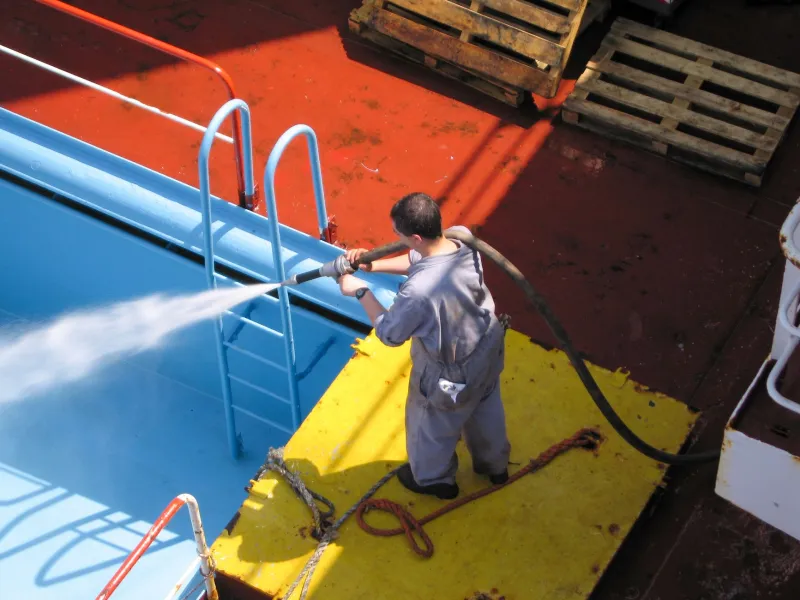
Once bacteria and their associated organic substrate penetrate below the surface layer, standard mopping and consumer-grade disinfectants are insufficient. The mechanical action required to extract embedded contamination demands professional-grade equipment: high-temperature steam, hot water extraction, or industrial power washing combined with appropriate detergent chemistry.
This is not a matter of effort — it is a matter of physics. Surface tension, absorption depth, and biofilm adhesion all exceed what conventional janitorial equipment can address after the 48-hour mark. The window for effective low-intervention cleaning closes quickly, and every hour of delay raises the intervention threshold.
A Realistic Scenario: The Loading Dock Incident
Consider a mid-sized food distribution facility in the Midwest. A pallet of packaged poultry products is damaged during unloading on a Thursday afternoon. The liquid byproduct — a mixture of organic fluids and processing residue — contacts the loading dock's concrete floor and seeps toward an interior threshold.
The evening crew mops the visible residue. The floor looks clean. By Friday morning, the area passes a visual check during the shift supervisor's walkthrough.
On Sunday, a routine third-party inspection is conducted. ATP swab readings near the threshold and along the adjacent wall base return values far above acceptable thresholds. Biofilm is identified in the grout lines. The inspector notes the proximity to a refrigerated staging area and escalates the finding. The facility receives a critical violation.
The cost: emergency professional remediation over the weekend, a follow-up inspection fee, mandatory documentation of corrective action, and a notation in the facility's inspection record — all stemming from a spill that was addressed visually but not microbiologically within the critical response window.
Had professional power washing intervention been deployed within 24 hours of the incident — using hot water extraction and appropriate surfactant chemistry — the biofilm would never have had the opportunity to establish itself.
What a Professional Response Actually Looks Like
Effective contamination response within the 72-hour window involves more than applying pressure to a surface. It requires a sequenced approach: pre-treatment with a pH-appropriate detergent to break down organic substrate, mechanical disruption via high-pressure hot water to lift embedded material, surface extraction to remove rather than redistribute contamination, and post-treatment verification to confirm microbial load reduction.
For facilities subject to regulatory oversight, this process should also generate documentation — a service record that identifies the affected area, the methods employed, and the date and time of intervention. That documentation becomes part of the facility's maintenance history and can serve as evidence of due diligence during inspections or in the event of a liability claim.
Professional cleaning providers with industrial experience understand these documentation requirements and can produce records that align with health department and OSHA expectations — a detail that distinguishes a reactive cleaning response from a strategically managed one.
Establishing a Spill Response Protocol
The most effective defense against the 72-hour contamination window is a standing protocol that eliminates decision latency. Facility managers should establish — in writing — a tiered response framework that defines what constitutes an immediate professional cleaning trigger versus a standard janitorial response.
Organic spills in food-adjacent or regulated zones should sit at the top of that trigger list, with a defined maximum response window and a designated professional cleaning contact. The cost of a single emergency service call is consistently lower than the cost of a failed inspection, a remediation project, or the operational disruption that follows a regulatory shutdown.
The biology does not wait for a convenient scheduling window. A response protocol that reflects that reality is not an operational luxury — it is a fundamental component of responsible facility management.
The Bottom Line
Bacterial colonization operates on a timeline that most visual inspection protocols are not designed to detect. By the time contamination is visible, or by the time an inspector's swab confirms a violation, the biological process that created that outcome began days earlier — often within hours of the initial spill.
The 72-hour window is the facility manager's most critical variable in contamination response. Closing that window with professional-grade intervention is not a reactive measure. It is the operational standard that keeps facilities compliant, protects their regulatory standing, and ensures that a minor incident remains exactly that.